Custom-Baked Papers: Uncovering the Rise of Tailor-Made Research Fraud
The paper mill is yesterday’s threat. Today’s fraud is bespoke, undetectable by plagiarism software, and sold to order.
📅 Jan 24, 2026✍️ ResearchFace Independent Investigator🔖 Forensic Analysis
🔬 Investigative Feature
For years, the fight against research misconduct has centered on the “factory” model—what the academic community calls the paper mill. Researchers and publishers have built sophisticated tools to catch recycled phrases, duplicate images, and plagiarized text. But the market has evolved. Enter the “custom baker.”
This is not a factory churning out identical loaves. The custom baker is a sophisticated service provider who designs unique fraud to order—tailored to a specific author, field, and target journal, all calibrated to the client's desired impact factor. The client might be a junior researcher desperate to build a publication portfolio, a PhD student cracking under graduation pressure, or a tenured professor juggling professional obligations while chasing a promotion. Money is rarely the obstacle, particularly when a grant, institutional funding, or a senior salary is already in hand.
This investigation does not rely on secondhand accounts or hypotheticals. It draws on verified documentary screenshots captured from active academic support networks operating across multiple languages and platforms, two anonymized interviews conducted under this platform’s source protection policy with participants on opposite sides of this market, and a forensic analysis of two explicit authorship-for-sale advertisements that expose the commercial logic driving this economy. What follows is a record of what is already happening—indexed, published, and counted in the metrics that determine who gets promoted, who receives funding, and which institutions rise in global rankings.
<
Why “Custom Baking” Outpaces the Standard Paper Mill
The difference between a traditional paper mill and a bespoke research service is both structural and consequential.
A paper mill mass-produces content—low-quality, repetitive, and increasingly detectable. A custom baker, by contrast, engineers originality. Because the work is written by human experts—often PhD or master’s degree holders with specialized knowledge in statistics, domain science, or foreign-language academic writing, many of whom are underemployed or freelancing—it bypasses every standard plagiarism detection tool and AI screening system currently deployed by journals.
Data is not copied. It is created. Using tools like MATLAB, SPSS, and Python, operators fabricate datasets engineered to produce publishable-looking results. Results may also be outright falsified. The baker guarantees the quality of the product and protects the client’s identity—a practice these services openly brand as “privacy as a service.” Some providers hide behind the legal veneer of “translation” or “academic consulting,” while quietly promising a unique manuscript, guaranteed to be indexed in Scopus or Web of Science.
Supply, Demand, and Institutional Desperation
This market does not operate in a vacuum. Institutional pressure fuels it.
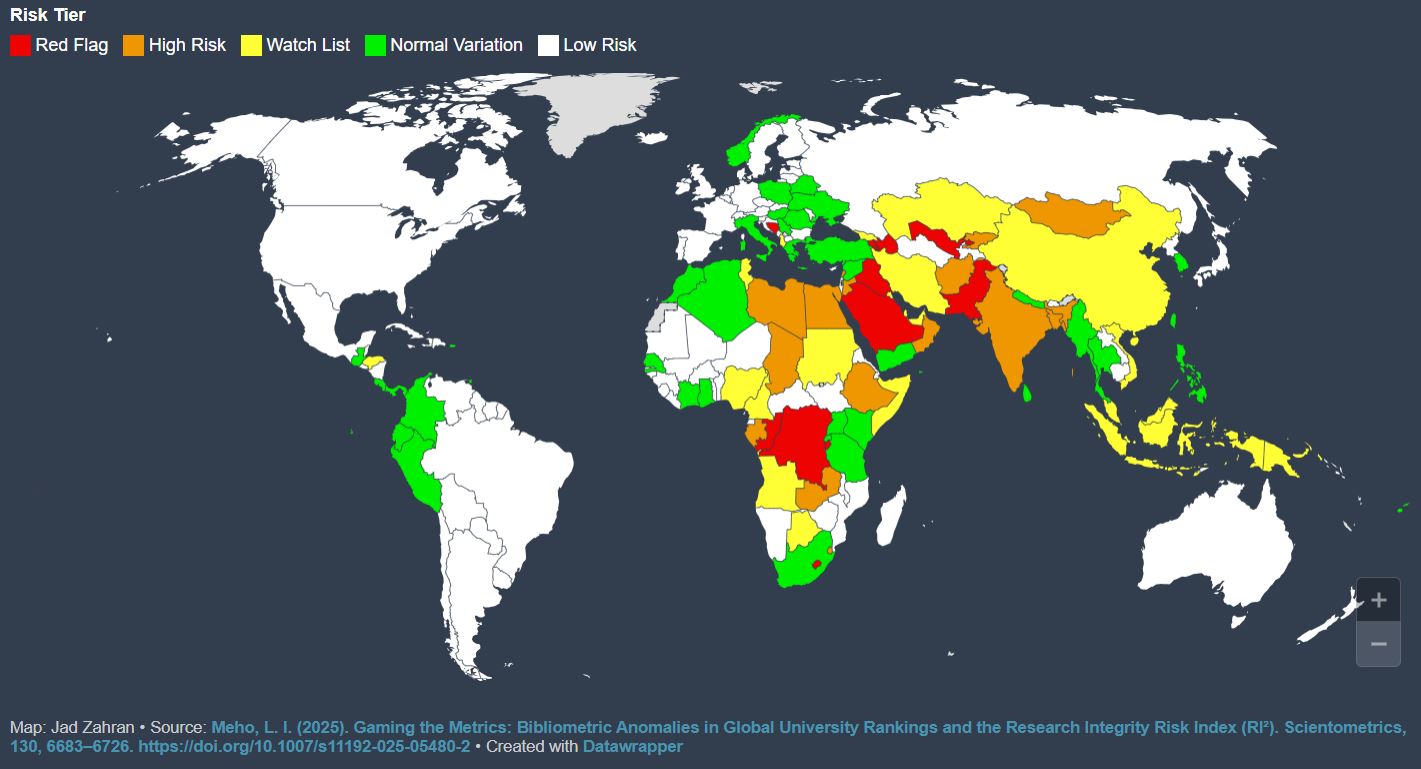
Applying the Research Integrity Risk Index (RI²)—a composite measure of structural research vulnerabilities across academic systems—a clear pattern emerges: universities in the “red zone” (high institutional risk) correlate strongly with the proliferation of illicit manuscript services, particularly across parts of the Arab world and China. When an institution requires publication in high-impact journals as a prerequisite for promotion or doctoral graduation, yet lacks the infrastructure to support genuine research, it generates a massive, ready-made client base for these services.
This is not a single, centralized operation. Each region has built its own market, in its own language, on its own platforms. Chinese-language networks operate primarily through WeChat channels, where providers post menus of ghostwriting services with pricing tiers for SSCI-level journals. Arabic-language markets run through WhatsApp groups and Telegram networks, where the transaction language shifts between formal academic terminology and the informal register of a service economy. English-language advertisements bridge both worlds, targeting researchers who cross regional markets in pursuit of higher-ranked journals. Every region has its fraud ecosystem, and every ecosystem is calibrated to the specific institutional pressures, reimbursement structures, and indexing requirements of its clients. The screenshots documented in this investigation span all three.
The RI² identifies where institutional pressure is highest. Social media marketing by these services reveals where that pressure finds its outlet. Advertisements circulating in Arabic, English, and Chinese—several of which are documented below—confirm the phenomenon’s global reach. The result is a vicious cycle: paid publications artificially inflate university rankings until the bubble bursts, as has already occurred with clusters of researchers at several institutions.
🔎 Documentary Evidence — English-Language Market
The Authorship Auction: Documentary Evidence
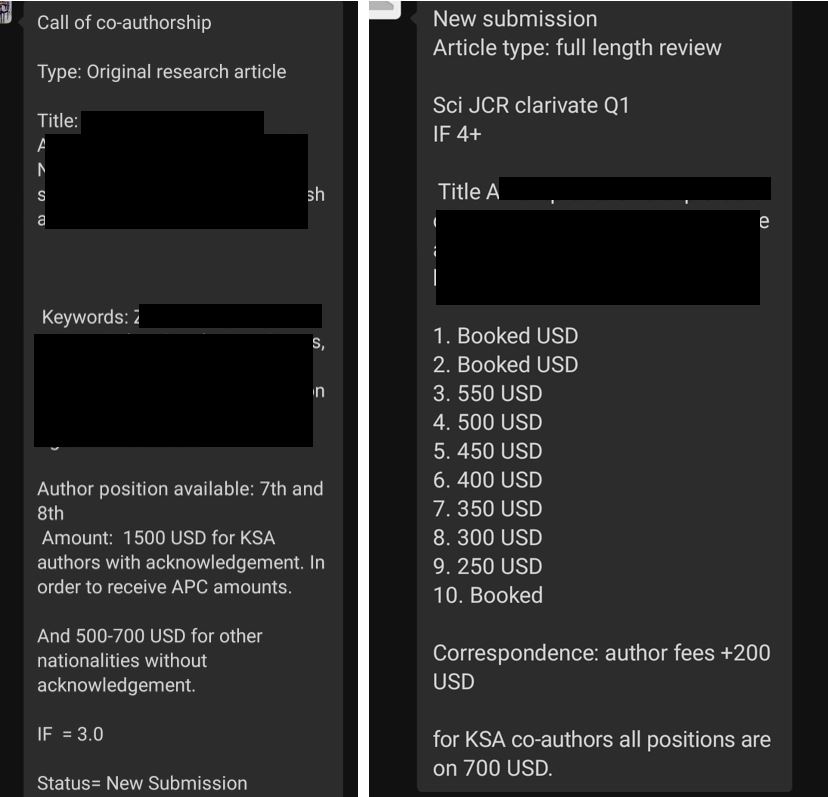
Two advertisements, one market. Nationality-based pricing (top) and Q1 journal position menu (bottom). Titles, keywords, and names redacted.
The two interviews above describe this market from the inside. The following advertisements—sourced from specialized academic “support” groups and reproduced here with titles, keywords, and author names redacted—document it from the outside. Both were originally posted in English.
In the boutique fraud market, the author list is no longer a record of contribution. It is a tiered investment portfolio.
Advertisement 1 reveals a National Pricing Model. A 7th or 8th author position sells to a Saudi Arabian buyer for $1,500, while buyers of other nationalities pay $500–$700 for the same position. The seller states the reason explicitly: “in order to receive APC amounts.”
This is Incentive Arbitrage. The KSA buyer is not paying for a line on their CV. They are buying a document they can submit to their institution to trigger an APC reimbursement that exceeds their purchase price. The seller has studied the market. The pricing reflects a precise understanding of Gulf university bonus and reimbursement structures.
The “Acknowledgement” feature offered at the $1,500 tier is equally revealing. Some universities require an author to appear in the acknowledgement section to qualify for institutional funding. The seller is not selling a name on a paper. They are selling proof—a document artifact designed to pass institutional verification.
Advertisement 2 completes the picture. It is a pricing menu for a Q1 journal review article, with author positions sold sequentially from highest to lowest price. The top positions are already marked “Booked.” What remains are the budget seats: positions 3 through 9, priced on a descending scale from $550 to $250.
Note the $200 premium for the corresponding author position. The corresponding author is the researcher of record—the point of contact for editors, the person accountable for the paper’s integrity. That accountability itself carries a surcharge. It is, in the most literal sense, the price of responsibility.
💰 The Arbitrage Logic
Buy: $1,500 for a co-author position. Submit: Institutional APC reimbursement claim. Collect: A payout that exceeds the purchase price. The authorship slot is not the product—it is the coupon.
Together, these two advertisements confirm what both interviews described: a functioning, structured, commercially sophisticated market in which authorship is a commodity, accountability is a product tier, and the scientific byline is a financial instrument.
🔎 Documentary Evidence — Chinese Market
The Price of Prestige: A WeChat Negotiation
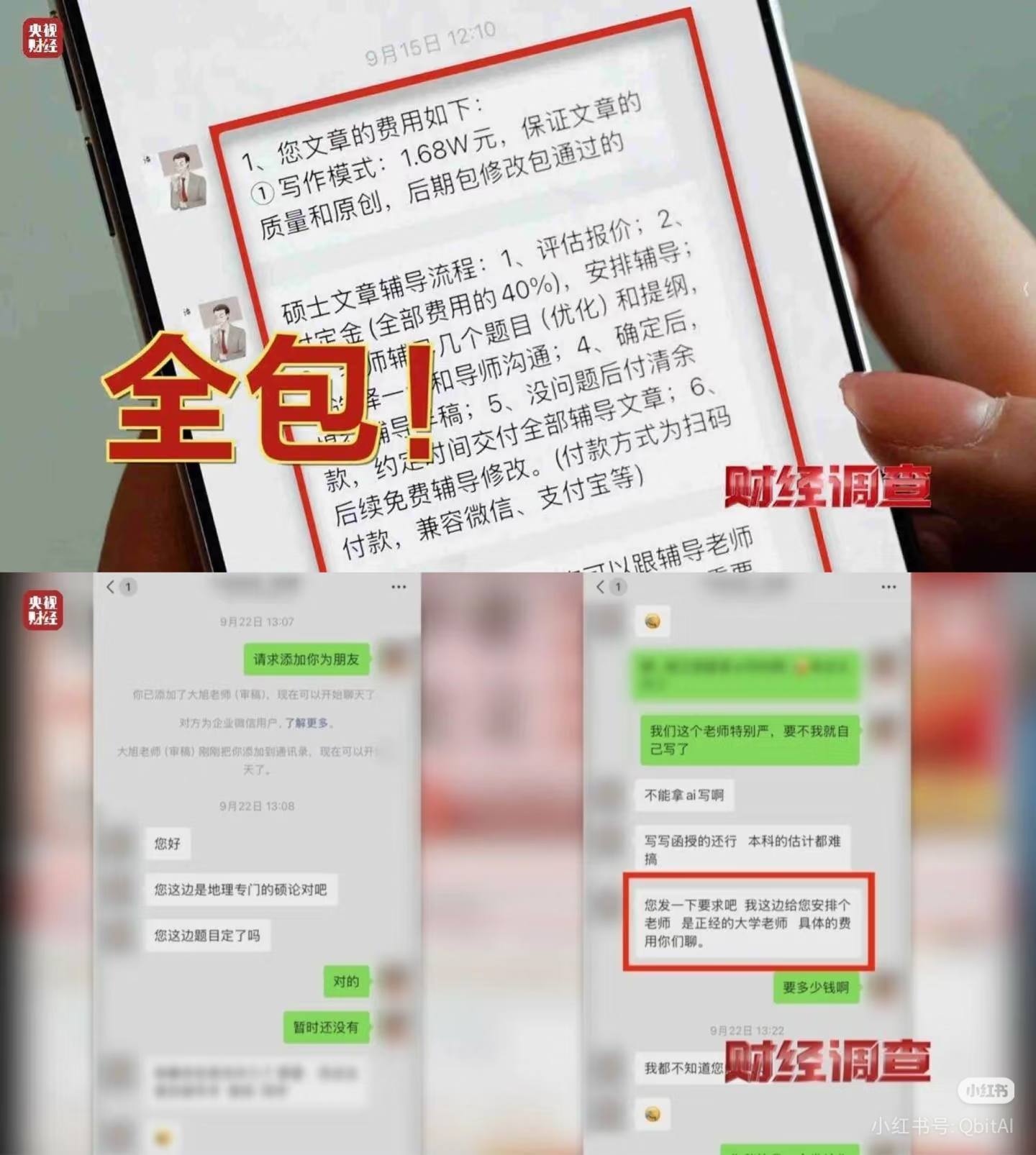
WeChat negotiation. 16,400 CNY (~$2,275 USD) for a guaranteed journal publication—captured at the moment of offer, before payment.
This screenshot, captured from a WeChat channel, documents the payment conditions of an active negotiation between a client and a service provider: 16,400 Chinese Yuan (~$2,275 USD at 2026 exchange rates) for a guaranteed journal publication. This is not a receipt. It is an offer—and the distinction matters, because it captures the market at the moment of transaction, before money changes hands, when the terms of academic fraud are still being openly discussed and agreed upon.
WeChat is a strategic choice, not a convenience. As both a messaging platform and a fully integrated payment system—alongside Alipay, which extends the same infrastructure to international users—it allows providers to negotiate, deliver, and collect payment inside a single, closed environment. It is familiar. It is trusted. And it is systematically difficult for outside monitors to access at scale. That combination makes it the Shadow Faculty’s preferred operating channel in China, for the same reason any market prefers an environment where transactions are visible to buyers and invisible to regulators.
📈 Market Pricing Logic
The 16,400 Yuan figure is mid-tier pricing. The Shadow Faculty scales its fees directly against a journal’s Impact Factor—the same metric universities use to evaluate their faculty. A Q1 medical journal publication can cost double or triple this amount. Prestige, in this market, has a published rate card.
👥 The Recruitment Mechanism
What the screenshot also reveals is how the provider repurposes this negotiation as marketing material—shared openly with prospective clients. When a provider displays an active deal, they are not merely advertising capability. They are deploying social proof: evidence that other researchers are already in this pipeline, already negotiating, already expecting delivery without consequence.
For a prospective buyer calculating personal risk, that is the most persuasive data point available.
The business model does not run on isolated transactions. It runs on a visible, compounding track record—each shared negotiation a recruitment tool, each published offer an open invitation.
🔎 Documentary Evidence — Arabic Market
The Arabic Conversations: Research as a Retail Transaction
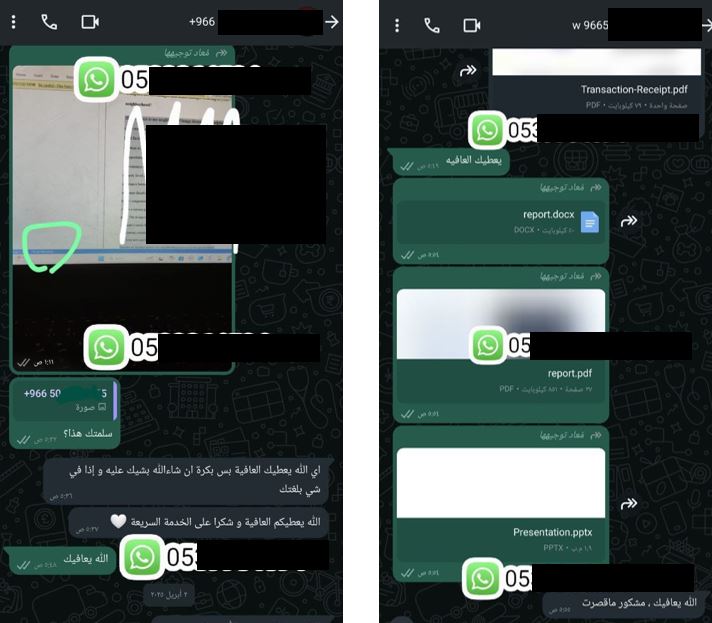
WhatsApp delivery package. Manuscript, statistical report, defense PowerPoint, and Transaction-Receipt.pdf.
These two screenshots document WhatsApp conversations in Arabic between a client and a service provider. The content is not a discussion of methodology or findings. It is a delivery confirmation.
The service provider sends a completion package: the finished manuscript, a full statistical report, and a PowerPoint presentation formatted for a doctoral defense or departmental review. Attached to the conversation thread is a transaction receipt—Transaction-Receipt.pdf—issued like an invoice for a commercial order.
That receipt is the forensic centerpiece of these two screenshots. It confirms, in documentary form, what the authorship advertisements only implied: in this shadow economy, a research paper is a product. It is ordered, manufactured, quality-checked, and delivered with proof of purchase. The only thing missing is a return policy.
But the receipt is not what lingers. What lingers is the client’s language. Across both
documented exchanges, that language is identical in character.
“Ya‘tik al-‘afiya — thank you, you didn’t fall short.”
“Ya‘tik al-‘afiya — thank you for the fast service.”
In Gulf Arabic, ya‘tik al-‘afiya — “may God give you health” — is a standard expression of gratitude for someone’s effort. Said once, it is courtesy. Repeated across every exchange, in every message, attached to words like “fast service” and “you didn’t fall short,” it is something else. It is relief.
This is not how a researcher talks after completing a study. This is how a relieved consumer talks after being rescued from a crisis. The phrase does not change — but its context exposes everything. A scholar who has just conducted rigorous analysis does not thank their collaborator for speed. A customer who has just cleared an institutional hurdle does.
The service provider is not an accomplice in the client’s mind. The service provider is a savior.
🕑 The Reframing Mechanism
By framing fraud as support, and academic violation as a customer experience, the operator has done something more insidious than sell a paper. The operator has neutralized the client’s ethical resistance entirely—replacing guilt with gratitude, and complicity with loyalty.
That psychological reframing is, in its own way, the most sophisticated element of the entire operation.
Note: These conversations have been translated from Arabic. The originals are retained by the author.
Parallel Market
🔎 Documentary Evidence — Chinese Market
The Chinese Requests: Publication as a Deliverable
A Chinese-language client request explicitly specifying an SSCI-level ghostwriting service. The client describes the paper’s requirements in terms of indexing tier—not academic contribution, not research question, not methodology.
The request treats publication in an SSCI journal as a deliverable: a product to be ordered, not a result to be earned through inquiry.
A Chinese-language exchange documenting a PhD dissertation ghostwriting request, with provider responses confirming availability and scope.
The PhD dissertation—the foundational credential of academic life, the document that certifies independent scholarly capacity—is treated here as a commissioned product with a delivery timeline and a price.
🎓 The Credential for Sale
In both screenshots, the defining pattern is identical: the client never mentions a question they want answered. They mention a metric they need met. The research question is irrelevant. The index is everything. This is not commissioning knowledge. This is ordering a certificate.
Note: These conversations have been translated from Chinese. The originals are retained by the author.
☣ Critical Sector Analysis
“Medical-Grade” Fabrication: When the Shadow Faculty Puts on a White Coat
The advertisements above document the market’s commercial skeleton. The two interviews that follow give it a face. But perhaps nowhere is the human cost more visible than in what the Shadow Faculty has done to medical publishing.
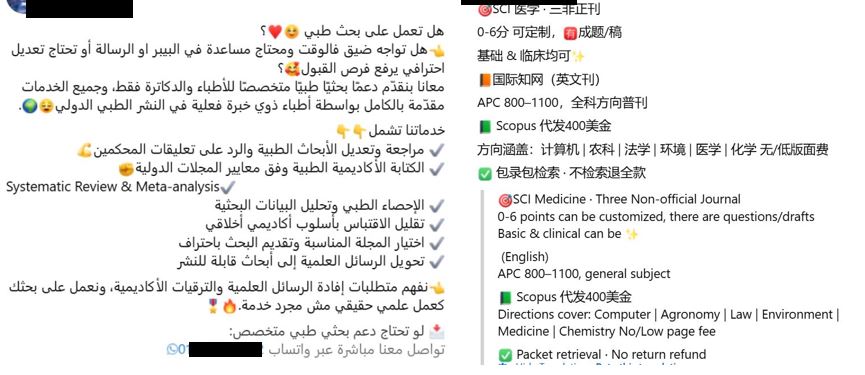
Two advertisements. Two languages. One market. Left: A Chinese-language service offering Impact Factor tiers on demand with pre-made manuscripts in storage. Right: An Arabic-language service marketed “for doctors only,” covering the full publication pipeline from systematic reviews to reviewer response letters.
Together, they document how the bespoke research economy has colonized medical publishing—and why that matters far beyond academic integrity scores.
📄 Chinese-Language Advertisement
Metric Procurement
The left advertisement dispenses with the pretense of “research support” entirely. This is Metric Procurement, stated openly. The service offers Impact Factor on demand—customizable between 0 and 6 points—which immediately reveals the logic of reverse-engineered science: the “Tailor” selects a target journal first, then fabricates a narrative and dataset engineered to satisfy that specific tier’s expectations.
The mention of pre-made drafts (有成题/稿) confirms something more chilling still: a Scientific Warehouse, an existing inventory of polished manuscripts sitting in storage, waiting for a buyer willing to pay $1,100 for a byline.
Key Forensic Detail
The full-refund guarantee is the most forensically significant detail in the entire advertisement. No legitimate academic service can guarantee publication. The Shadow Faculty can—because it has already mapped the peer-review system well enough to treat acceptance as a commercial transaction, not an intellectual hurdle.
📄 Arabic-Language Advertisement
Prestige Engineering
The right advertisement sells something the Chinese ad does not bother with: prestige. Marketed explicitly “for doctors only” and staffed, it claims, by “doctors with actual experience in international medical publishing,” this is not a mill. It is designed to look like an elite medical residency support network.
The service list covers every stage of the publication pipeline—systematic reviews, meta-analyses, statistical analysis, reviewer response letters, journal selection—and closes with the most revealing phrase in the advertisement:
“Plagiarism reduction in an ethical academic style.”
That phrase is not reassurance. It is a technical specification. It signals manual rewriting, not software spinning—text rebuilt by hand to survive forensic linguistic screening.
Target Market Indicators
1. The explicit reference to “academic promotions” confirms this service is architected around the same institutional incentive structures the RI² index identifies in high-retraction medical research regions: publish or stall.
2. The emphasis on systematic reviews and meta-analyses is equally deliberate. These are dry-lab studies. They require no patients, no laboratory, no physical data collection. A skilled operator can manipulate data from existing public studies to engineer a pre-determined, statistically plausible result—high-impact output with zero experimental risk.
Together, the two advertisements map the full commercial architecture. The Chinese ad eliminates financial risk. The Arabic ad eliminates professional shame. One sells a transaction; the other sells an identity. And that distinction explains why this tier of the shadow market is so difficult to detect and so resistant to standard integrity tools.
⚠ Clinical Harm Vector
This is not a victimless crime, and the harm does not stay inside a university ranking table. Arabic-language fabrication networks and Chinese-language fabrication networks operate in entirely separate digital environments—divided by language, platform, and local trust infrastructure—but their outputs accumulate in the same place: the global scientific record.
A commissioned meta-analysis produced for an institutional promotion in Riyadh and a fabricated clinical dataset assembled for a regional journal in Beijing may never share a server. They share a citation database. When clinicians unknowingly base treatment decisions on guidelines derived from this manufactured evidence, the contamination becomes clinical. The health risk is cumulative and compounding.
This is no longer a fight against plagiarism. It is a fight against industrial-scale corruption of the global evidence base—one that has learned to wear a stethoscope.
🗣 Anonymized Interviews
Inside the Market: Two Voices, Both Anonymous
The documentary evidence—from authorship auctions to medical-grade fabrication services—establishes the infrastructure. The interviews establish the human logic behind it.
The Buyer: Pressure as a Business Model
Academic fraud does not begin with dishonesty. In most cases documented in this investigation, it begins with exhaustion.
An associate professor at a university in one of the Gulf states—a region where institutional salaries are high and universities are in aggressive competition for global ranking positions—agreed to speak on condition of full anonymity, in accordance with this platform’s source protection policy. Her account is not exceptional. It is representative.
“I have a family and children, and I’m under immense teaching pressure with publication deadlines. I have to submit research for promotion. I need a researcher who can guarantee publication in a Web of Science–indexed SSCI or SCIE journal.”
Three forces converge in that single statement. First, a domestic labor burden that her institution does not count and does not accommodate. Second, a publication mandate that her institution enforces without flexibility. Third, a market that has identified this exact gap and built a service to fill it. She is not looking for someone to think for her. She is looking for someone to deliver a specific, verifiable, indexed output—because that output is the only currency her institution recognizes. The Shadow Faculty accepts that currency and charges accordingly.
The Seller: The Researcher Who Monetizes Himself
If the buyer’s story is about pressure, the seller’s story is about a calculation—rational in its logic, fraudulent in its consequences.
An assistant professor who operates simultaneously as a legitimate researcher and an active participant in the authorship resale market agreed to speak anonymously under the same source protection policy. He does not see himself as a fraudster. He sees himself as solving a problem his institution created and refuses to acknowledge.
“I don’t sell research unless I’m listed as an author, but I can be the last author if someone pays me to relinquish the first author position. I can also sell the corresponding author position for an additional fee.”
This is not opportunistic fraud. It is a structured, tiered business model—one that mirrors the pricing logic of the advertisements analyzed in the next section. He writes the paper. He retains authorship. He then sells the remaining author positions to buyers who contributed nothing to the work, at prices that vary by rank.
When asked directly why he adds names to papers—knowing his university already covers his open-access publishing costs—his answer was unambiguous:
“Because I get tired and spend a lot of time preparing and analyzing data and writing, and because some clients contact me asking me to add their names to my articles because they simply can’t dedicate time to doing their own research.”
The logic is circular and self-sealing. His university pays twice: once for the research, and once for the APC. The buyer pays once for a publication record they did not earn. The journal receives a submission it cannot distinguish from legitimate collaborative work. Everyone profits except the scientific record.
⚠ The Cover Mechanism
But the transaction does not end with the sale. The harder problem is sustainability—specifically, how a seller justifies a byline that includes authors from entirely different countries who contributed nothing. When asked how he handles that question if his university inquires, his answer revealed a system that has thought through its own cover:
“Simply, I conduct international studies. Most of the time, we claim that the data was collected from the country of the majority of the authors—the clients who buy the authorship positions. Most of the data are questionnaires or interviews. The journals cannot ask for the original records—voice records of the interviews—especially if they are in another language. No one has time to check.”
This is the mechanism that makes boutique fraud durable. The seller does not fabricate a collaboration. He constructs a plausible one—anchored in a methodology that is inherently difficult to verify, in a language that peer reviewers rarely speak, in a country where no one will follow up. Questionnaire data collected in a foreign country, from a foreign population, analyzed by a researcher whose university lists him as co-investigator: on paper, it is indistinguishable from legitimate international research. In practice, it is a cover story engineered to survive editorial scrutiny—and, according to him, it does.
🌎 Geospatial Intelligence
Mapping the Market: The RI² Index and the Geography of Fraud
The RI² (Research Integrity Risk Index) map is not a passive summary of retraction statistics. It is a geographic heatmap of the Bespoke Research Tailoring market—and when the documentary evidence from these screenshots is laid over it, the correspondence is not coincidental. It is structural.
RI² Global Heatmap: Geographic distribution of research integrity risk. Zones correspond to concentrations of authorship-for-sale activity documented in this investigation. Map source:https://sites.aub.edu.lb/lmeho/ri2/map/
🔎
Reading the Map
The map identifies ■ Red Flag zones carrying the highest retraction rates in their respective regions. ■ Orange regions register in the High Risk tier, where the “Publish or Perish” culture has outpaced local oversight—institutional promotion mandates requiring Q1/Q2 publications often lack a matching research infrastructure, creating fertile ground for boutique fraud services. ■ Yellow zones suggest relative stabilization or better internal monitoring, though sheer publication volume means even a low fraud percentage still produces a significant number of bespoke papers entering the global record.
■ Green and ■ White zones represent stable or clean bibliometric environments—regions where institutional mandates are either less aggressive, research ecosystems are more transparent, or the density of target journals is too low to attract shadow markets. These are the least profitable terrain for international fraud syndicates: the cost-benefit arithmetic simply does not justify targeted operations. A researcher in a White zone produces in relative safety; one in a Red Flag zone is statistically far more likely to be targeted by a “Tailor.”
These are not random concentrations. They are the direct output of institutional environments where publication in indexed journals is a prerequisite for promotion, doctoral graduation, or access to research bonuses—but where the infrastructure to support genuine research production at the required volume simply does not exist.
Red Flag — Critical
Orange — Elevated
Yellow — Moderate
Green — Stable
White — Clean
The RI² map shows us where the demand is highest. The authorship advertisements show us exactly how that demand is being monetized.
🔗
The “Silo” Effect Between Risk Zones
Geographic neighbors can exist in entirely different integrity ecosystems based on local university policies. More critically, the two largest fraud markets operate in completely separate digital silos—making cross-market detection nearly impossible for any single monitoring system.
🌍 Arabic Market Silo
WhatsAppFacebookTelegram
Open advertising in academic groups. Pricing in USD pegged to nationality. Direct broker-to-client negotiations visible across ■ Red and ■ Orange zones.
🇨🇳 Chinese Market Silo
WeChatWeiboBaidu
Behind the Great Firewall. Separate platform ecosystem. Massive volume in the ■ Yellow zone but structurally invisible to Arabic-market investigators.
🔑 Key Insight: The risk is not just about where the paper is written, but where the pressure is highest. A researcher in a Red Flag zone is statistically far more likely to be targeted by a “Tailor” than one in a White zone.
💰
Incentive Arbitrage in Red Flag Zones
Return to the first advertisements for co-authorship. The 300% KSA pricing premium is not a coincidence. It is a calculated response to a specific institutional reality: Saudi universities offer substantial cash bonuses for publication in high-impact indexed journals. The fraudster has read the incentive structure, priced accordingly, and built a National Pricing Model that extracts maximum revenue from maximum institutional pressure.
The Arbitrage Loop
🏫 University Bonus e.g. $5,000–$20,000
→
💰 Authorship Cost e.g. $1,500–$3,000
→
📈 Net Profit +$3,500–$17,000
→
📊 RI² Impact Retraction spike
The institutional bonus exceeds the purchase price. The authorship slot is not the product—it is the coupon.
The RI² map’s Red Flag designation is the downstream consequence of this arithmetic. High institutional reward, insufficient research infrastructure, and a mature fraud market producing purchasable publications at scale—the result is a surge in low-integrity papers that eventually surfaces as an elevated retraction rate on a global map.
The map shows us where the fire is. The screenshots show us who is selling the matches.
This is not a story about academic mistakes in high-pressure regions. It is a story about a multi-million dollar industry that has read the global university ranking system with precision—and found exactly where integrity is most profitable to break.
🔬 Forensic Methodology
A Forensic Analysis of Custom Fraud
The skilled operator—the “master baker”—typically works within a network or small firm that also provides legitimate services: translation, editing, proofreading, and statistical consulting on real data. This cover is deliberate. But when fabricating a custom paper, even the most careful operator leaves traces. Three forensic signatures appear consistently.
1
Statistical Perfume
To make a paper appear technically sophisticated, master bakers often enlist a statistician. The result is the misapplication of advanced methods—deep learning architectures, transformer models, BiLSTMs—applied to trivially simple datasets. A paper might deploy a T5 language model to analyze basic school grades. This “statistical perfume” is designed to intimidate non-specialist editors and reviewers, masking the fact that the underlying data is fabricated.
⚠ Detection cue: A complex AI architecture applied to a dataset that a linear regression could handle is not methodological rigor—it is camouflage.
2
The 80% Accuracy Trap
Amateur fabricators report suspiciously perfect accuracy rates—99%, with no error. Smarter operators aim for a more credible 80–85%. But they still fail what we call the “baseline test.” If a complex AI model achieves 80% accuracy, yet the authors never compare it to a simple benchmark model—a random forest, a logistic regression—that omission is itself a red flag. It suggests the complex model was selected precisely because its outputs are easier to manipulate programmatically.
⚠ Detection cue: No baseline comparison + suspiciously round accuracy + high-complexity model = the fabrication trifecta.
This is the most common forensic fingerprint. A fabricator constructs a comparison between control and experimental groups. Eager to demonstrate dramatic success, they apply “improvement points” to everyone—including the control group. In psychology, education, or medicine, this creates a logical impossibility: a group that received no treatment spontaneously acquires a complex skill, or recovers from a condition, at a rate that defies human biology and behavioral science.
⚠ Detection cue: A control group that improves dramatically without intervention is not a statistical anomaly—it is proof of fabrication.
The custom baker can fake data. They can fake statistics. But they cannot fake the logic of human behavior—and that is where every fabrication eventually fails.
🛡 Policy Framework
Recommendations: The Anti-Paper-Bakery Protocol
Stopping this form of fraud requires moving beyond text-matching. We must shift to logical auditing and metadata forensics. The following measures are proposed for journal editors and peer reviewers.
🗃
Data & File Integrity
1. Scrutinize Metadata and Source Files
Editors should examine file properties, not just file contents. Are document creator names linked to consulting firms? Journals should require submission of original project source files—not polished spreadsheets, but raw MATLAB (.m) files, SPSS (.sav) files with complete command logs, or Python notebooks with full execution histories. Faking an 80% accuracy score in a spreadsheet is straightforward. Fabricating months of coherent programming history is not.
2. The 7-Day Raw Data Window
When reviewers have reason to doubt the data, journals should enforce a strict raw-data disclosure policy: authors must submit element-level raw data—original survey responses, unprocessed sensor records—within seven days of the request. A legitimate researcher can produce that material quickly. Generating thousands of rows of internally consistent fabricated data in the same window is a different matter entirely.
3. Mandate the Baseline Comparison
Reviewers should require that any high-complexity model—deep learning, transformers, ensemble architectures—be benchmarked against a standard baseline such as linear regression, XGBoost, or a random forest. The absence of a baseline comparison is not a minor methodological gap. It is a significant red flag.
🔍
Methodological Auditing
4. Audit Logical Context
Does the control group behave like an actual human control group? If an intervention outperforms the global standard by a factor of five, that is not a scientific breakthrough—it is a fabrication. Reviewers should treat extraordinary results with proportionate scrutiny.
5. Flag Non-Standard Measures
Papers that use undefined or non-standard measurement instruments should receive a formal integrity label during review. By inventing metrics, fraudsters prevent direct comparison with legitimate research, making fabrication harder to detect from the outside.
6. Audit “Systematic Review” Logic
Editors should be suspicious of Systematic Reviews submitted by clinical doctors with no formal training in epidemiology or statistics. If the meta-analysis is “too clean” (low heterogeneity) but the author cannot explain the specific weighting used for individual studies, it may be a “Sharks Office” product.
👥
Authorship & Network Integrity
7. Verify Corresponding Author Accountability
As the authorship advertisements document, the corresponding author position is itself for sale at a premium. Editors should treat the corresponding author as the accountability anchor of the review process. Where a corresponding author cannot answer specific technical questions about methodology, statistical approach, or data collection—or consistently defers to unnamed collaborators—the paper warrants an authorship integrity review.
8. Audit Implausible International Collaborations
The seller’s own testimony in this investigation explains how cross-national authorship is constructed as cover. Journals should request a Collaboration Statement when five or more authors from three or more countries share no prior publication history, no documented institutional connection, and no co-grant record—particularly when the declared data collection method is questionnaire or interview-based in a foreign-language context.
9. Cross-Reference the “Doctor” Network
If multiple papers from different hospitals in the same region use identical statistical software versions, identical phrasing in the “Limitations” section, or the same WhatsApp-linked contact metadata, they should be flagged as part of a coordinated “Consultancy” batch.
🏛
Institutional & Systemic Measures
10. Index Institutional Risk
Indexing services like Scopus and Web of Science should move beyond journal-level quality standards and begin factoring institutional integrity risk—as measured by the RI²—into their alert systems. Editors should receive a risk signal when a submission originates from a high-risk institutional environment.
11. The “Reviewer Response” Proxy
This ad offers to “respond to reviewers’ comments.” Editors should watch for responses that are overly polite but technically vague, or responses that come in within hours of a major revision request—a sign that a professional “fixer” is handling the back-and-forth.
The paper mill was a factory. The paper bakery is a consultancy. Detection must evolve accordingly—from pattern-matching to forensic auditing, from text similarity to logical coherence, from journal-level gatekeeping to institutional-level risk indexing.
📚 Primary Sources for the RI² Index
Meho, L. I. (2025). Gaming the metrics: Bibliometric anomalies in global
university rankings and the Research Integrity Risk Index (RI²).
Scientometrics, 130, 6683–6726.
https://doi.org/10.1007/s11192-025-05480-2
Next in the Investigative Pipeline…
🏥 “The Patient File”
Custom-baked papers do not stay in filing cabinets. In medicine and public health, they reach patients. This investigation traces fabricated clinical evidence from a purchased manuscript through citation chains into treatment guidelines—mapping how a single fraudulent study can influence real-world medical decisions. The supply chain of fraud does not end at publication. It ends at the bedside.